



Discover what makes Abu Dhabi property future-proof, from smart planning and strong demand to long-term growth and buyer protection.
Anyone who has bought property before knows the real question isn’t “Is this a good deal today?” It’s “Will this still be a good decision in ten years?” Prices go up and down. Trends come and go. What actually matters is whether the ground you’re standing on—literally and financially—holds up over time.
That’s what we mean when we talk about Abu Dhabi property being future-proof. Not that prices only go up, because no market works that way. It means the fundamentals underneath the market are solid enough that short-term noise doesn’t knock things off course. Here’s what’s actually behind that.
The city isn’t growing by accident.
“Is Abu Dhabi’s expansion a plan, not a rush? Roads, transport links, new districts, and business zones—all of it is mapped out years ahead of time. You can see this if you drive through newer communities: schools, clinics, and retail tend to arrive alongside the housing, not years after it. That’s not always true in fast-growing cities, where new developments get built first and the infrastructure catches up later, if it catches up at all. Buyers notice the difference, and it shows up in how well those areas hold value.
The economy doesn’t depend on one thing anymore.
Abu Dhabi used to be an oil story. It isn’t anymore, or at least not primarily. Non-oil activity now makes up more than half of the emirate’s economic output, with real momentum coming from tourism, finance, industry, and technology. This matters for property owners more than it might seem to at first. A city whose income depends on one industry tends to have a property market that swings hard with that industry. A more balanced economy tends to produce a steadier one—fewer boom-bust cycles, more predictable long-term demand.
People keep moving here, and that’s the real driver.
Every property market ultimately comes down to one question: are there enough people who want to live there? Abu Dhabi’s population has been climbing steadily, and most projections have that continuing for years to come. That’s not just a statistic—it reflects people choosing to build careers and raise families in the city, not just pass through it. Rental demand and resale demand both trace back to this one number more than almost anything else.
The rules actually protect you.
This one doesn’t get talked about enough, but it’s arguably the most important. Many buyers face problems not because of the location but because of weak property regulations. Abu Dhabi has strengthened buyer protection with clear ownership laws, escrow accounts for off-plan projects, registered developers, and transparent transaction records. These safeguards help buyers invest with greater confidence.
There’s something for almost everyone.
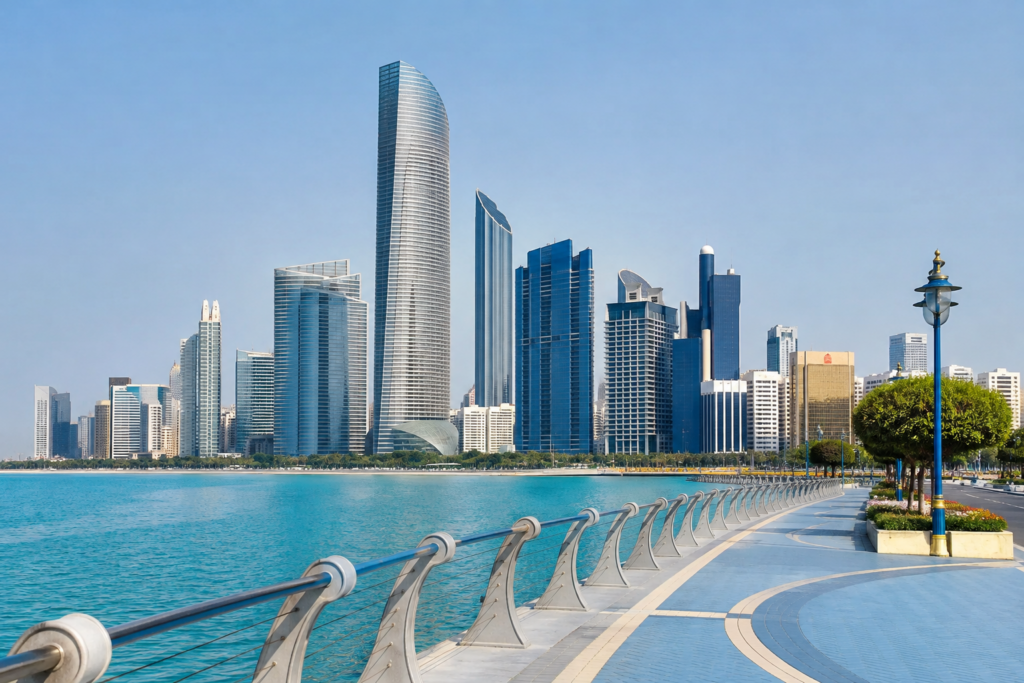
Not every future-proof property looks the same. Abu Dhabi’s market spans apartments on Al Reem Island, family villas in the newer suburban communities, and waterfront homes on Saadiyat and Yas. That range matters because it means demand isn’t riding on one type of buyer. A market that only appeals to investors, or only to families, or only to one income bracket, is more fragile than one that draws from all of them.
Owning property here can mean more than owning property.
The Golden Visa changed the calculation for a lot of international buyers. Property above a certain value can now come with a path to long-term residency, which turns a purchase into something closer to a life decision than a pure investment. When people are buying property because they want to actually live and work in a place long-term, that demand tends to be stickier—less likely to disappear the moment the market cools.
The infrastructure keeps getting better, not worse.
You might not notice it until you’re stuck in traffic with no metro line in sight. Abu Dhabi continues to invest in transport, utilities, healthcare, and schools, making neighborhoods more livable—even those built years ago, not just the newest communities. Well-connected communities tend to hold their value better than isolated ones, almost regardless of what else is happening in the wider market.
The bottom line
None of this guarantees that every property in Abu Dhabi is a good buy—no city can promise that. Abu Dhabi has the right foundations for long-term property value. Strong planning, a diversified economy, steady population growth, and clear regulations help create a stable market for buyers and investors.
Our team at Sustainable Homes Real Estate can help you find the right property for your goals